


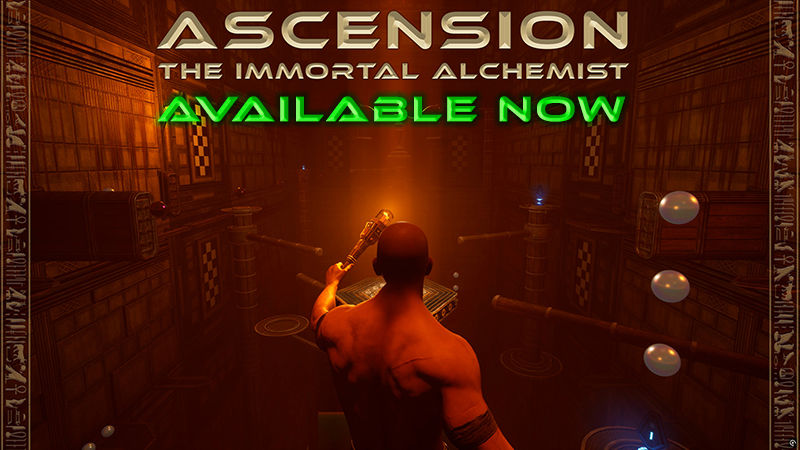
Ascension - Solving industry problems


When setting out to develop Ascension - The Immortal Alchemist, the developers at Violet Flame Studios were aware of persistent problems inherent to the industry and its consumer practices.
From psychological warfare techniques, exploitation of brain chemistry, social and political indoctrination to the promotion of gambling - The Immortal Alchemist endeavor's to do things differently.
So, What Problems does "Ascension - The Immortal Alchemist" Solves as a product?
1. The Lack of Meaningful Difficulty
Problem:
Many modern games flatten challenge to maximize accessibility, resulting in experiences that rarely demand focus, discipline, or growth. Difficulty is often adjustable rather than integral to the design.
How Ascension Solves It:
Ascension treats difficulty as the core mechanic, not a modifier. Progression is earned through:
Precision execution
Pattern recognition
Timing, patience, and memory
Failure is instructional, not punitive — making improvement tangible and deeply satisfying.
Product Value:
Players seeking real mastery finally get a game that respects their intelligence and effort.
2. Shallow Progression & Disposable Experiences
Problem:
Many games rely on extrinsic rewards (loot, cosmetics, power scaling) to simulate progress, leading to short engagement cycles and forgettable experiences.
How Ascension Solves It:
Progression in Ascension is internal and skill-based:
Player ability improves, not stats
Mechanics unfold through trials, not tutorials
Advancement feels personal and earned
Product Value:
Ascension creates lasting engagement — players remember what they overcame.
3. Low Watchability in Skill-Based Games
Problem:
Many mechanically deep games are difficult to read or boring to watch, limiting organic discovery via streaming and social platforms.
How Ascension Solves It:
Ascension is intentionally watchable:
Clear success/failure states
High-tension sequences with immediate consequences
Visible mastery moments (clean runs, clutch saves, resets)
Product Value:
The game naturally generates shareable moments without forced spectacle.
4. Speedrunning Games Without Depth
Problem:
Some games unintentionally become speedrunning-friendly but lack long-term routing depth or execution ceilings.
How Ascension Solves It:
Ascension is architected for mastery:
Repeatable trials
Route optimization opportunities
Risk/reward decisions that meaningfully affect runs
Product Value:
The game supports a long-tail competitive ecosystem (speedrunning, challenges, mastery runs).
5. Thematic Disconnect in High-Difficulty Games
Problem:
Difficulty is often arbitrary or disconnected from narrative and theme.
How Ascension Solves It:
Ascension’s difficulty is diegetic:
Trials represent initiation and ascension
Failure is narratively justified
Mastery mirrors spiritual and philosophical growth
Product Value:
Challenge feels purposeful, not cruel.
6. Player Fatigue From Over-Guided Design
Problem:
Modern games often over-explain, over-mark, and over-direct players, reducing agency and discovery.
How Ascension Solves It:
Ascension trusts the player:
Minimal hand-holding
Systems revealed through interaction
Observation and experimentation are required
Product Value:
Players feel respected — not micro-managed.
7. Indie Games That Lack a Clear Identity
Problem:
Many indie titles blend into genre noise due to unclear positioning.
How Ascension Solves It:
Ascension has a singular, coherent identity:
Precision platformer
Initiatory structure
Hermetic philosophical core
Mastery-first ethos
Product Value:
It’s instantly legible to the right audience — and unapologetically not for everyone.


Comments